
Zero Damage: Star Citizen’s Armor Threshold, Or Why Your Gun Is Now A Very Expensive Flashlight
Since Alpha 4.7, Star Citizen's ship armor checks every incoming bullet against a threshold and returns either full damage or absolutely nothing. No ramp, no falloff, just a cliff. Here's how that one choice turned alpha damage into a bouncer at a door and every other weapon stat into upholstery.
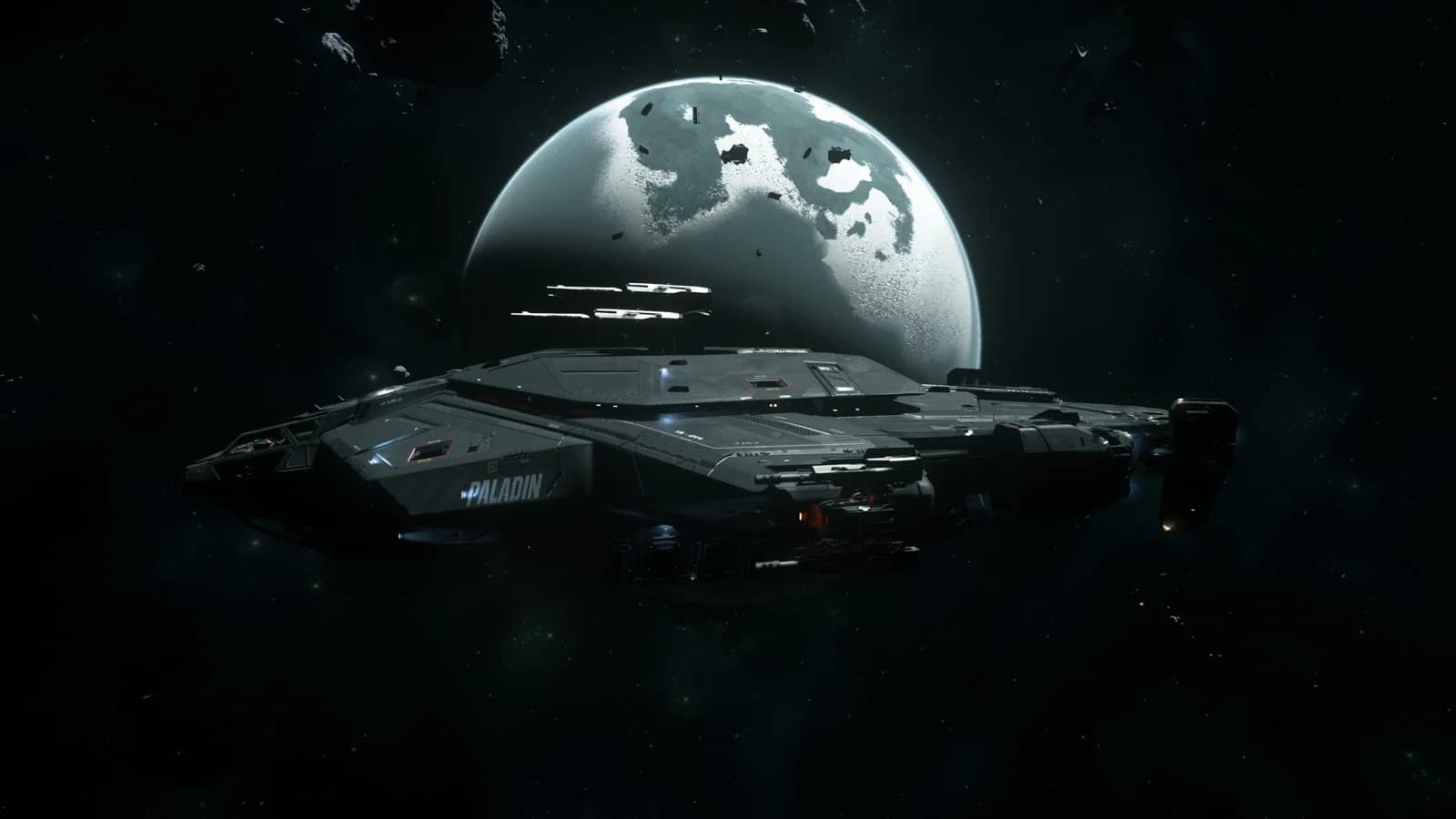
There is a specific and deeply modern kind of despair that comes from doing everything right and having absolutely nothing happen.
You have been building toward this moment. You have chosen a ship. You have chosen weapons for the ship, which involved eleven browser tabs, a spreadsheet, and a YouTube video by a man with a headset microphone who says "so basically" one hundred and forty times. You have flown out to a big scary target. You have lined it up. You have squeezed the trigger, and your ship has emitted a satisfying quantity of glowing ordnance in the general direction of the enemy, and the ordnance has struck the enemy, and the enemy has responded by:
Doing nothing.
Not shrugging it off. Not taking a little damage. Nothing. Zero. The universe has looked at your carefully assembled loadout, consulted a table, and returned an integer, and the integer was 0, and this is now (as of Alpha 4.7, and still very much the case in 4.10) a working feature rather than a bug, which is the sort of sentence that should make a systems designer sit up very straight in their chair.
The Three Doors
Star Citizen currently resolves ship damage through three layers, which I encourage you to imagine as three doors between your bullets and the delicious component nougat at the center of an enemy vessel.
Door One is shields. Shields are the polite door. Shields are a big regenerating pool of hit points and they behave the way hit points have behaved since roughly 1974: you hit them, a number goes down, everybody understands what happened. Energy weapons are especially good at this and got even better at it in 4.10.
Door Three is the hull and its components. Power plants, shield generators, thrusters, and the various expensive boxes that make a spaceship a spaceship rather than a very fast filing cabinet.
Door Two is armor. And Door Two is where we need to have a conversation.
Armor does not work like a hit point pool. Armor works like a bouncer. Armor looks at each individual bullet as it arrives, checks its damage-per-hit against a number, and if that bullet's number is smaller than the bouncer's number, the bullet does not get in. It also does not damage the armor. It also does not damage the hull. It also does not damage the components behind the hull. It does not do anything. It is, functionally, a photon-based expression of disappointment.
This is called a minimum damage threshold, and it was introduced in 4.7 with the entirely reasonable goal of making ship class matter. Before it, a light fighter could patiently orbit a Perseus and eventually saw it in half, which is not a thing that should be true, and CIG was right to want it not to be true.
The problem is not the goal. The goal is fine. The problem is that the mechanic is a step function.
A One-Point Cliff
Here is how the threshold behaves, as players discovered fairly quickly and with the sort of enthusiasm you would expect: if your weapon does exactly as much damage per shot as the armor threshold, your full damage goes through. If it does one point less, you do no damage at all.
One point.
Not "reduced damage." Not "you'll be here a while." Nothing. There is no ramp, no falloff, no graceful anything. There is a cliff, and on one side of the cliff is a functioning weapon and on the other side of the cliff is a device that converts capacitor charge into pretty lights.
Now, an important nuance, because I want to be fair: once the armor has been worn down (by somebody, anybody, with a big enough gun), the smaller weapons start working again. This is a genuinely elegant idea about fleet composition. It is also, if you are flying alone at three in the morning because that's when the servers are least haunted, a sentence that means "you personally cannot participate in this fight."
Where Weapon Choice Quietly Dies
Here is the thing that actually matters, and it is the sort of thing that is easy to miss because it doesn't look like a bug and nobody files a ticket about it.
A stat that gates access to the system dominates every other stat in the system.
Alpha damage is no longer one interesting axis among several. It is a bouncer at a door. It is an eligibility check that runs before anything else is allowed to be relevant. Fire rate, projectile velocity, spread, range, ammo capacity, handling, the pleasing noise the gun makes: all of these can now only function as tiebreakers among the weapons that already got past the bouncer. Everything below the gate is upholstery.
Consider two Size 3 ballistic weapons currently in the game. Same size. Same damage type. You could bolt either one to the same hardpoint on the same ship without thinking about it very hard.
The SW16BR3 "Shredder" repeater fires at 750 RPM for 45 damage a shot, which comes out to 562.5 DPS in a burst, or 480.9 sustained across a full minute.
The Deadbolt III cannon fires at 100 RPM for 225.4 damage a shot, which comes out to 375.7 DPS in a burst, or 298.5 sustained.
Read those again, because the interesting part is not that they are close. They are not close. The Shredder puts out about fifty percent more damage per second in a burst, and better than sixty percent more sustained. By the only metric the game used to care about before 4.7, the Shredder is simply the better gun. Seven and a half times the rate of fire in exchange for one-fifth the punch, and it comes out ahead on the exchange.
It is also the one that does nothing.
Then armor arrives with a threshold sitting between the two. The Deadbolt's 225.4 clears it and the Shredder's 45 does not, and that advantage does not shrink or degrade or get halved. It is simply not applied. The Shredder's 2,589 rounds of ammunition and 1,480 m/s projectiles and generous shot grouping are now features of a device that, against an intact armored hull, produces no effect of any kind.
That is not a trade-off. A trade-off is when both options win somewhere. This is a right answer wearing a trade-off's coat, and the wrong answer is the one with the better numbers.
And it cascades. Because you cannot re-fit mid-flight, and because in an open-world PvP game you do not get to choose who jumps you, the rational play is to always mount the highest-alpha weapon that physically fits, forever. It costs you nothing against soft targets. It is the only thing that works against hard ones. Every pilot independently reasons their way to the same loadout, and a catalogue of 183 ship weapons collapses into about four functional categories separated by threshold bands, inside of which the differences are essentially cosmetic.
The decision has also moved. It used to happen in the fight: read the range, read the shields, read what the other pilot is doing. Now it happens in a spreadsheet, before you undock, against a number the game does not tell you.
Exhibit A: CIG's Patch Notes
I am not making this up. From the live 4.10 notes:
- Size 4 ballistic gatlings had their damage increased by approximately 68% per round, because they had been quietly inheriting Size 3 ammunition and were therefore, in the game's own words, failing to "defeat armor as intended."
- The Size 7 ballistic gatling on the Ares Inferno had to be fixed to properly damage large ship armor like the Hammerhead. A Size 7 gun. On a dedicated gunship. Could not hurt a Hammerhead.
- Destroyed armor was, until this patch, still mitigating damage at zero health. Armor with no health left was still doing its job, like a ghost that hasn't been told.
In a continuous damage system, each of those is a weapon underperforming by ten or fifteen percent and somebody eventually notices. In a threshold system, each of those is a weapon class doing nothing at all for an entire patch cycle. There is no graceful degradation. A small numeric mistake produces total functional failure, and the balance workload scales as ships × weapons × forever.
Meanwhile, in 4.9, the Ares Ion's penetration distance went from 10.5 meters to 1.3 meters, with its effect radius collapsing from half a meter to seven centimeters, while the Inferno's went from 7.7 meters up to 15.3. Those are not tuning passes. Those are personality transplants performed on shipped, purchased products.
But... There Are Good Parts
The armor system is not a disaster, to be clear, because "this specific mechanic is a step function and should be a curve" is a much smaller and more actionable complaint than "everything is bad."
Ship class does mean something now, and it didn't before. Armor has an identity distinct from shields: one is a regenerating quantitative soak, the other a non-regenerating qualitative filter, and two defensive layers that behave differently is better design than two health bars in a trench coat. Ballistics and energy finally have real jobs after years of being the same gun in different hats. Armor depletes, which feeds the engineering and repair loop and gives attrition somewhere to live.
And crucially, CIG left a very good escape hatch: external components aren't protected by armor at all. Turrets, thrusters, sensors, point defense: all of it is out in the weather. A light fighter that can't scratch a capital's hull can still methodically remove its ability to shoot back. That is a genuinely well-chosen pressure valve, and it's the reason the whole thing hasn't fallen over.
There's also a working model sitting right next to the broken one. Penetration distance (base distance, near radius, far radius, damage tapering smoothly to zero) is continuous, produces real trade-offs, and gives different weapons meaningfully different jobs. Same design idea. Implemented as a curve instead of a step. Works fine.
Some Cheap Fixes
None of this requires burning the system down.
- Make the step a curve. Effective damage scales as some function of alpha over threshold: brutally penalized underneath it, never actually zero. The class hierarchy survives. The cliff doesn't.
- Or just subtract.
damage_through = max(0, alpha − armor_rating). Small guns chip at terrible efficiency, which is the honest version of what the threshold is trying to say anyway. - Scope the threshold to armor health only. Let sub-threshold fire always contribute to attrition even if it never reaches the hull. Nobody's shooting is ever meaningless.
- Let sustained fire soften. Accumulated hits temporarily lower the local threshold. Gatlings open, cannons close. Mixed loadouts become a choice instead of a fleet requirement.
- Show the numbers. Armor rating in the target info, required alpha in the loadout screen. 4.9 added hit markers specifically so players could tell whether they were doing anything, which is a fascinating admission: the mechanic needed a UI layer bolted on before it became perceptible at all. A hidden step function is not a mechanic. It's a bug report generator with excellent uptime.
The real cost that doesn't show up in a spreadsheet: the worst possible feedback a game can give a player is nothing. Reduced damage teaches. A tough fight teaches. Zero damage is indistinguishable from desync, from a missed shot, from a broken weapon, from the server having a small private crisis. The player doesn't learn "wrong tool." The player learns "this game is broken," closes it, and goes to do something with a more reliable relationship between cause and effect, like taxes.
TL;DR
- What it is: Since 4.7, ship armor has a minimum damage-per-shot threshold. Under it, your bullets do zero: no armor damage, no hull damage, no component damage. Over it, full damage. Layers go shields → armor → hull/components.
- It's binary. One point short of the threshold means nothing happens. There is no ramp. It's a cliff.
- This makes alpha a gate, not a trade-off. Any stat that decides whether the rest of the system applies to you dominates the rest of the system. DPS, velocity, spread, and handling become tiebreakers among weapons that already qualified.
- Case in point: the S3 Shredder repeater (45 alpha, 750 RPM, 562.5 DPS) out-damages the S3 Deadbolt III cannon (225.4 alpha, 100 RPM, 375.7 DPS) by about fifty percent on paper. Against intact armor the Deadbolt works and the Shredder does nothing. The better gun is the useless one; only the alpha number survived.
- Loadouts converge. You can't refit mid-flight and you don't pick your fights, so everyone mounts max alpha always. 183 weapons collapse into a handful of threshold bands.
- Tuning errors become catastrophes. 4.10 had to buff S4 ballistic gatlings by ~68% per round and fix a Size 7 gatling that couldn't hurt a Hammerhead. No graceful degradation means a 10% mistake reads as total failure.
- The good parts are real: ship class finally matters, armor has an identity separate from shields, ballistics vs. energy is meaningful, and unarmored external components keep fighters relevant against capitals. Good escape hatch.
- The fix is small: make the step a curve (or a flat subtraction), let sub-threshold fire still wear armor down, and surface the numbers in the UI.
- The real problem: zero damage is the worst feedback signal in game design. It's indistinguishable from a bug, and players don't debug: they quit.
Weapon figures in this piece come from spviewer.eu, read against build 4.10.0.12519617. Alpha and rate of fire are per weapon; DPS is quoted as burst, with the sustained sixty-second figure alongside it where the difference matters. These numbers move every patch, so if you are reading this well after 4.10 and the arithmetic looks off, that is why.